A community behind the scenes – Volunteers make DocPoint happen 

This year’s DocPoint Documentary Film Festival gathered more volunteer applications than ever before – due to the popularity the call had to be closed earlier than planned. Altogether 124 enthusiastic volunteers aged 17–76 were chosen to work at the festival. The multitude of volunteers’ tasks ranged from ticket sales to ushering and from driving to communications. We visited the volunteers to find out what brings them to the festival.


Community-enthusiast Ruusu returns to a familiar task


Ruusu Kallioinen – ticket sales

What made you apply as a volunteer to DocPoint this year?

I have volunteered at DocPoint since 2019. I have also volunteered at the Love & Anarchy film festival and the Midnight Sun Film Festival. Usually I have worked at ticket sales, but I have also been a theatre supervisor and an usher. After several years of volunteer work I look forward to meeting familiar faces and the community that has formed at festivals, but most of all I am eager to use my free tickets to see the films of DocPoint.

Which film are you particularly excited for?

I haven’t decided my full schedule for the week, but I am at least looking forward to Mikki Noroila’s Karelian language short film Yritin šuaha hänet kuvah onnakko hiän kato.

Photo: Alejandro Ramirez


First-timer Aliisa was driven by their passion for films

Aliisa Ylikoski: Communications

What made you apply as a volunteer to DocPoint this year?

Films are an important hobby for me and I spend most of my free time watching them. I wanted to experience something new, catch a glimpse of work in the culture sector and since I only moved to the Helsinki area recently, I also wanted to meet new people. I work with marketing and communications, so the communications team appealed to me the most.

What are your tasks at the festival like?

I have done all kinds of assisting communications tasks both at the DocPoint office as well as at the theatres participating in the festival. I have, for example, translated texts, written social media posts, interviewed festival-goers and photographed material for social media.

Which films are you planning to see yourself?

Today, on the opening day of the festival, I’m planning to see the film Housewife of the Year. That is one of many films I find interesting.

Manuel is intrigued by the Finnish film scene

Manuel Díaz Tufino: Info desk

What made you apply as a volunteer to DocPoint?

I became a volunteer for the opportunity to see films, meet new people and see the vibe of the Finnish film industry. This is my first time at DocPoint, but I have volunteered once at Love & Anarchy, also at the info desk.

What is the most interesting part of your volunteer post?

The most interesting aspects of the info desk are to learn Finnish by working and interacting with people. Also, it’s interesting to be where the festival happens and experience it more deeply instead of just passing by briefly as a visitor.

Which film or films are you most looking forward to?

I’m looking forward to the film A Family, which explores very painful tensions and conflicts within a family. I’m also eager to see the film Apple Cider Vinegar since I share the filmmakers’ fascination with stones. Preemptive listening also seems really interesting, alarm sounds are a fascinating topic. Also, the amount of Q&As at Docpoint surprised me! It’s great to hear more about the film from its creator.

Photo: Giovanni-Ferri

Roberto gets energized by meeting like minded people

Roberto Puentes: Photographer

Have you volunteered before and what made you apply this year?

This is my second time volunteering at DocPoint festival. I have also volunteered at the Love & Anarchy film festival and I am actively involved in the Cinemaissí film festival that showcases Latin American film.

The community formed around film festivals motivates me to be an active part in them. Interacting with people who share similar interests gives me energy. I obviously love films and I find documentaries a very important form of film. Through them you can convey important portrayals of societies at a certain time and of people.

What is working as a photographer at DocPoint like?

I move from one theatre and event to another and try to capture the atmosphere of the festival on camera and communicate through photographs and video. I enjoy photographing and being behind the camera and observing situations. For me, photographing at Docpoint does not even feel like work – I really enjoy it. I’m always having fun; I get to see familiar faces, meet new people and to contribute to the work of the Finnish film industry.

What kind of people would you recommend working at DocPoint for?

Anyone who is interested in stories and people, and who feels like they would be able to contribute to the festival. Other factors, like age, gender or background, do not matter. That is what’s best about this.

Which films at DocPoint do you recommend?

I really enjoyed An Echo of You. It was so refreshing to see elderly people on screen and hear their stories. White House Effect was also great. It was actually almost sad to see how long climate change has been discussed, but it is important that it is continuously brought up. I am also looking forward to the film Wisdom of Happiness – having moved from Mexico to Finland I have seen two very different approaches to happiness. I would also like to recommend the 20th Cinemaissi film festival happening next autumn.

Photo: Alejandro Ramirez

Lili enjoys checking tickets and sharing the experience

Lili Eweis: Vahtimestari

Have you volunteered before and what made you apply this year?

I have meant to apply for many years, but have always missed the call. But now I’m here! I have also volunteered at other festivals before, so the work is familiar.

Which tasks are included in your volunteer post and how have you liked them?

I inspect customers’ tickets and introduce the film. We also clean the biggest trash after each screening. I really like ticket inspection: There’s something fun seeing people in a film-going-mood and being able to say “welcome, enjoy the film” to them.

What is the best thing about volunteering?

I like being able to get to know the industry and movie theatres this way. The reward of getting to see films is also great – it’s really worth it. I also love meeting people who share similar interests. And all the customers who come to the screenings, we share something together at that moment.

Which film are you most looking forward to?

I am most excited for the film I’m Not Everything I Want to Be. I also saw Lesvia, it was really good.

Photo: Elsa Meklin


First-timer Gisela volunteered for her interest in films


Have you volunteered before and what made you apply this year?

This is my first time ever volunteering at any film festival. This is a nice place to start and I gain useful experience. I am interested in films and thought that this would be a nice experience.

Which tasks are included in your volunteer post and how have you liked them?

The major task is the ticket inspection, and introducing the move to the audience. So far I have liked it a lot, it is really fun. It has been nice to meet people and everyone has been in a good mood.

Which film are you most looking forward to?

I am most excited for the films Two Forests and I’m Not Everything I Want to Be.


Volunteers Are a Vital Part of DocPoint


The volunteers at DocPoint are the heart of the festival, and their contribution is invaluable to its success. Volunteers not only take care of practical arrangements but also bring joy, a sense of community, and enthusiasm. The festival’s executive director, Johanna Råman, emphasizes the importance of volunteer work for DocPoint and its audience:

“Volunteers play an absolutely vital role in making DocPoint happen. Without them, none of this would be possible. In uncertain times, people long for meaningful encounters. It’s fantastic if our festival can be a unifying and community-building experience for our volunteers from diverse backgrounds.”

Volunteers bring a wide range of skills to the festival, some of which the organizers could never have anticipated, making their contributions even more valuable. Different backgrounds and experiences enrich the event in many ways:

“It’s amazing how volunteers bring in expertise that we didn’t even expect. DocPoint volunteers have very diverse backgrounds and skills. The best part is when we can match these skills with the right tasks, allowing volunteers to gain meaningful experience. It’s also wonderful to hear that volunteers have met each other through their work and made new friends along the way,” says Riikka Haapanen, volunteer coordinator and former volunteer.

If this year’s DocPoint inspired you to volunteer, now is the perfect time to follow the festival’s channels! Next year’s volunteer application process will open at the end of the year, and the first to hear about it will be those following DocPoint’s social media and subscribing to the newsletter. Don’t miss the chance to be part of a unique festival community!

Photo: Roberto Puentes

Noora Järnefelt, Aliisa Ylikoski, Elsa Meklin, Moritz Müller, Irina Hasala, Viima Nurmi

Cover Photo: Alejandro Ramirez
DocPoint 2025 Opening Words by Inka Achté

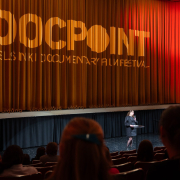
DocPoint 2025 began on Tuesday, Feb 4, with a full Bio Rex Lasipalatsi screening of Arantzazu Gomez Bayon’s Forget About Cinema! Minister of Science and Culture Mari-Leena Talvitie and DocPoint’s Head of Programming Inka Achté opened the screening. You can read Achté’s opening speech below.

Dear guests,

It is an immense pleasure to have you all here at the 24th edition of DocPoint. 

I am also deeply grateful, because this is not a given. Our current government has chastised Finnish arts and culture to the extent that has left many paralysed or withering. This is not only short sighted, but also uninformed from an economic point of view. Arts and culture nourish the soul of a society and create the basis of a strong community, and they have distinct importance in employing people and bringing in tax euros. 

Marian Wright Edelman, an American activist for the rights of children, said the famous words “you can’t be what you can’t see.” She was talking about the importance of representation and role models in shaping children’s aspirations and opportunities, but the same is true of all of us. Without representation -images, symphonies, stories, films- about us and by us , there is no us.

But I don’t think I need to preach to this audience about how vital shared stories are in creating a shared sense of identity and values. Let’s talk about documentary film, nonfiction cinema. Documentary films are not just about reporting on an unusual phenomenon or telling an unbelievable story. They also have the incredible power of transporting us into the experience of a person whose experience we may otherwise not have any access to. 

I can not think of anything more important in a highly polarized era where it has become so impossible for people to understand each other and converse with each other (this is why, by the way, polarisation and community have been the core themes of this year’s DocPoint programme).

What I also love about the non-fiction form is how versatile and creative it can be in expressing something about the world. We are living in a time where people have become accustomed to consuming non-fiction on VOD platforms such as Netflix. However, it could be argued that these platforms have also done a disservice to documentary film. They are driven by algorithms, prioritizing over- produced, slick content that has mass appeal and performs well with broad audiences, stifling creative author driven documentaries with independent and original point of views which we could experience collectively in a cinema, like we are today. 

The film we are going to see as an opening film tonight, Forget About Cinema! by Aranatzazu Gomez Bayon is a powerful testament – and a much needed reminder in this era of VOD domination – of the power of creative documentary as a genre. The title Forget About Cinema! seems tragicomically apt in this era of budget cuts to Finnish arts and culture, but in the film the title has a more personal meaning.

While being acutely aware of the history of cinema, this film, almost in an anarchistic way, refuses to be categorized. The filmmaker combines observational cinema, reconstruction, symbolism and essay film, to tell a deeply personal yet universal story about trying to remain yourself while becoming a mother.

Ladies and gentlemen and everyone in between, please give a warm welcome to the director of Forget About Cinema!, Aranatzazu Gomez Bayon!

Inka Achté

Image: Sami Sorasalmi

International Juries select the winners of the DocPoint Competitions

DocPoint will award the best national and international films, as well as the best Finnish short films, with DocPoint Awards on festival Saturday. The winners are selected by juries composed of film industry professionals. In our interview, the jury members share their expectations for the festival and the competing films.

In DocPoint’s three Competitions, the top films of the festival programme compete. The award ceremony on Saturday night will reveal which films have become the juries’ favourites. The jury members are an international group of film industry professionals. In this article, the jury members share their thoughts.

The jury for the National Competition includes Bérénice Hahn from sales agency Square Eyes, filmmaker and founder of the Academy of Moving People And Images Erol Mintaş, and Hubert Sabino-Brunette, the artistic director of the Canadian RIDM festival.

The jury for the International Competition includes documentary filmmaker Maija Hirvonen, the artistic director of DokuFest Kosovo Veton Nurkollari, and Brazilian filmmaker, actress, and director Renata Ferraz.

The jury for the National Shorts Competition includes filmmaker Iiti Yli-Harja, PhD researcher and filmmaker Kazu Ahmed, and artist Maija Blåfield.

Hubert Sabino-Brunette

What are you hoping to see in DocPoint’s Competition films?
I am very pleased to have access to the best of Finnish documentary creation from last year, a national cinema that we have little access to in Montréal. So I’m excited to see the richness and the diversity of this production in a condensed period. It’s also my first time in Finland. And since documentary cinema reveals parts of the culture of a country, its history and the perspectives of the people who live there, I am very much looking forward to knowing more.

What things do you pay attention to when watching a film as a jury member?
I like to be confronted by personal perspectives on the world and on cinema. In a film, I want to see a unique point of view, a singular cinematographic approach; a signature of the filmmakers. So, I pay a lot of attention to aesthetics, narrative structure and process. I also leave space for emotions, for the sensitive, so it’s not only about the cerebral or the reasoned thinking. It’s also about feelings.

Were you already familiar with DocPoint, and what are your expectations for the upcoming festival?
I am familiar with the program of the festival, but this is my first time at DocPoint. I’m looking forward to seeing the good things that I’ve heard and read over the years. I am eager to experience the general atmosphere of the festival, to discuss with people of the local cinema community and also to meet the public, thus to encounter and experience the cinephile life and the environment in which it unfolds.

Maija Hirvonen

What are you hoping to see in DocPoint’s Competition films?
I’m hoping to get into situations I wouldn’t normally have access to and get close to people I would never meet in real life. I don’t have any other expectations, and I don’t want to know anything about the films beforehand.

What things do you pay attention to when watching a film as a jury member?
It’s a good sign if, while watching, the film captivates me so much that I can only analyse the filmmaking techniques afterward.

Were you already familiar with DocPoint, and what are your expectations for the upcoming festival?
I think I first went in 2004. Some of my all-time favorite films I’ve seen specifically in DocPoint’s programme, like Forugh Farrokhzad’s The House is Black or Lindiwe Matshikiza’s One Take Grace. I’ve gotten used to trusting that the festival’s selection will work, even if I choose the films blindly. It’s also nice to gather with fellow filmmakers, something that doesn’t happen too often.

Veton Nurkollari

What are you hoping to see in DocPoint’s Competition films?

I am confident in saying that the quality of the films in the International Competition that I have seen already is very high. I hope that the rest of the films are of similar quality, too, even if it would make our work as jurors more difficult.

What things do you pay attention to when watching a film as a jury member?

There are a number of things that I pay attention to when watching a film as a jury member, such as the story and the way it is told. I also pay attention to how it was filmed and edited, two very important elements that help a film to stand out when executed good. And finally, I look for any authorial touch, a moment or two that distinguishes the filmmakers from the rest.

Were you already familiar with DocPoint, and what are your expectations for the upcoming festival?

I am familiar with DocPoint, having visited for the first time some 15 years ago. Since then, I have been following it closely, especially its programming of Finnish documentaries. I expect yet another great edition of the festival.

Renata Ferraz

What are you hoping to see in DocPoint’s Competition films?
In today’s world, I hope to be surprised by the diversity of themes and by non-canonical ways of making films, with characters that contribute to the construction of new imaginaries—both in cinema and in life. I also hope to see more equivalent relationships on screen between those in front of and behind the camera, contributing to a more balanced process of cinematic creation.

What things do you pay attention to when watching a film as a jury member?
As a filmmaker, I sometimes wish I could, but I can no longer watch a film without thinking about its construction. My gaze as a jury member is quite similar to the one I have when I’m not. I pay attention to the chosen narrative—in both theme and form—and technical aspects: image, sound, editing, direction, and so on. But above all, especially in the context of documentaries, I focus on the questions involved in the relationship between those who film and those who allow themselves to be filmed.

Were you already familiar with DocPoint, and what are your expectations for the upcoming festival?
I showed our film Rising Sun Blues (Rua dos Anjos) at DocPoint last year. It was an exciting experience, not just because of the quality and diversity of the films, but also because of the warmth and dedication of the entire team. I experienced a sense of equivalence in the relationships that I found quite fascinating. The audience was also very attentive and engaged. This year, I hope the encounter between the audience and the films will be just as powerful as it was last year, so that together—filmmakers, audiences, jurors, and festival programmers—we can imagine and create new worlds, different from the paths we are heading towards.

Iiti Yli-Harja

What are you hoping to see in DocPoint’s Competition films?
It’s amazing to get to experience the world from many different perspectives. I hope for surprises and films that radiate the joy of filmmaking!

What things do you pay attention to when watching a film as a jury member?
I hope the film evokes a wide range of emotions in me and stays in my mind for a long time. Technical perfection isn’t the most important thing to me—sometimes small imperfections make a film feel more alive and human. The rhythm of the film is absolutely crucial: how it moves forward, keeps your attention, or leaves space for realisations. If the film surprises with clever sound and music choices, it makes an impression.

Were you already familiar with DocPoint, and what are your expectations for the upcoming festival?

DocPoint has been an important place for many of my films to be seen. This year, I’m involved in a new role, and in addition to the films, I’m looking forward to all the encounters: new and old friends, and after small talk, the deeper (or lighter) conversations about films and everything else!

Kazu Ahmed

What are you hoping to see in DocPoint’s Competition films?
I am coming with a very open mind. With an institution like DocPoint, to be honest, I wouldn’t like to come with my own ideas of viewing. But rather an excitement about what treats are in store for me. So in that sense, I am hoping to see a selection that reflects DocPoint’s experience, expertise and reputation.

What things do you pay attention to when watching a film as a jury member?
I tell everyone that I look at films as a very ordinary viewer. Not as an expert. And truly so, as I have no claims of being one. Even as an ordinary viewer, aesthetics, coherence/articulation in narrative and visual representation of the chosen subject, treatment and approach, ethical considerations etc. are important for me to form an opinion about a film. But most of all I look at how the film is “speaking to me”. Literally. Documentary/non-fiction films are one of the most effective ways of creating conversation and dialogue. They, along with the filmmaker, are not just very powerful prompters of discussion in the public domain, but are agents of change too. At the heart of that potential to create public discourse is the nature of language used to speak to the audience. This, for me, determines the nature and scale of response from the viewer. So how far a film is able to hold what kind of conversation and among who are some of the things that I pay attention to.

Were you already familiar with DocPoint, and what are your expectations for the upcoming festival?
Of course I have been familiar with DocPoint and it is an honour to be part of this current edition. I am part of something called the Cultureels Ethnographic Film Collective and we look at DocPoint as a trendsetter in many of the things that we aspire to do. As I mentioned earlier, I come with an open mind. What I expect, though, is a very rich learning experience, which I am sure to get. As someone who is a student and a teacher of visual media, this is important and exciting for me.  With so many excellent filmmakers and their work, and DocPoint’s curation/selection, I wouldn’t imagine otherwise.

Inari Ylinen

Editorial: Cinematic Sparks of Hope

DocPoint’s Head of Programming Inka Achté introduces the films and main themes of the 2025 festival in her editorial.

Greetings, dear friends of documentaries!

The new year has begun, which means that DocPoint will soon delight documentary film enthusiasts by bringing the latest and most captivating real-life stories to theaters. The past year has been harsh in many ways. In Finland, the government initiated massive cuts affecting students, asylum seekers, and the unemployed, not forgetting art and culture. Globally, wars raged; Israel continued its genocide in Palestine, and Russia pursued its war of aggression in Ukraine. To the surprise of many, despite an assassination attempt, Donald Trump will/has once again become the President of the United States.

What remains unchanged is the climate crisis threatening life on Earth. DocPoint’s Climate Report series features a selection of films highlighting the alarming state of our planet. The Here Now Project, composed of smartphone footage by ordinary people, shows that in an environmental crisis, the truth is more terrifying than any disaster film. Searching for Amani takes us to Kenya, where a mysterious murder opens the eyes of an aspiring young journalist to the deadly effects of colonialism and climate change. The White House Effect, using archival material, illustrates how global concern for our warming planet transformed into a matter of opinion over thirty years.

DIVERGING PERSPECTIVES

Our era is marked by ideological and political polarization. People with differing views seem unable to sit at the same table. The superpower of documentaries lies in their ability to place the viewer in someone else’s shoes, offering perspectives that differ from their own. Polarization is a symptom of democratic erosion, which is why the familiar Democracy in Distress series includes several documentaries addressing this issue. Premiered at the Venice Film Festival, Homegrown follows what drives devoted Trump supporters to storm the Capitol after Joe Biden’s victory in the U.S. presidential election.

Awarded for Best Directing at IDFA, An American Pastoral portrays school board elections in a small town in Pennsylvania, where the struggle between right-wing conservatives and liberals mirrors the broader societal divide. Apocalypse in the Tropics shows how evangelical Christianity influenced Jair Bolsonaro’s rise to power in Brazil. We also get a glimpse of Russia in renowned Czech director Filip Remunda’s latest film, Happiness to All, featuring a devout Putin supporter living in Siberia. Of Caravan and the Dogs follows the increasingly impossible lives of Russian journalists and human rights activists before and during the war in Ukraine. Both films will serve as a starting point for the DocFocus discussion Journalism in a Polarised World, organized in collaboration with the Union of Journalists in Finland.

As the opposite of polarization, one might consider a functioning community. The thematic series Stronger Together offers cinematic sparks of hope for viewers feeling anxious in a divided world. The healing power of the community is showcased in films like Balomanía, about hot air balloon enthusiasts in Brazil’s favelas, the laughter-inducing Pavilion 6, set at a Croatian vaccination center, and the pastel-colored musical documentary Reas, diving into the lives of Argentinean female prisoners. Abortion Dream Team follows Polish women fighting for abortion rights in a country with the strictest abortion laws in Europe. Director Karolina Domagalska will attend the festival and participate in the DocFocus discussion Activists as Defenders of Abortion Rights on Saturday, February 8, organized with Amnesty International Finland.

WARMTH AMID THE WINTER COLD

Adding warmth to February’s frosts are the music documentaries in the Feel the Beat series, continuing for the third year, and films under the Long Live Love theme, exploring diverse forms of love. We will meet the late composer genius Leif Segerstam in LEif and queer icon and musician Peaches in Peaches Goes Bananas, premiered in Venice. Lesvia tells the story of women who found a safe haven on the beautiful island of Lesbos, while Trust Me introduces a Berlin couple opening their relationship due to the husband’s yearning for freedom. The Flamingo follows 60-year-old Mary’s journey into the world of BDSM after years of celibacy and divorce. Director Adam Sekuler and protagonist Mary Phillips will attend DocPoint to answer audience questions.

The competition series includes films that are not only distinctive and reflective of their directors but also showcase the diversity of documentary cinema as an art form. In the international competition, Apple Cider Vinegar by Sophie Benoot starts with a kidney stone and evolves into an exploration of stones (and much more). Writing Hawa by Najiba Noor depicts the lives of the women in her family as they change when the Taliban rises to power in Afghanistan. A Fidai Film by Kamal Aljafari is an experimental work based on archival material stolen by the Israeli army from a Palestinian research center in Beirut during the Lebanon War. Mother Vera paints a sensory portrait of a nun at a crossroads in her life, living in a Belarusian monastery.

The films in the Finnish competition are delightfully diverse in style. The opening film, Forget About Cinema! by Arantzazu Gomez Bayon, is a stunning, category-defying depiction of balancing artistry and motherhood, placing the filmmaker within the canon of her predecessors with sharp insight. Two Forests by Jan Ijäs explores aging and death through Japanese forest myths. In the Borderland by Elina Hyvärinen is an observational documentary about the municipality of Parikkala and its residents’ changing relationship with Russia after the war in Ukraine begins.

Director Olli Laine’s ambitious Matti Nykänen – The Legend is part of the Fruits of Labour series, examining how our identities intertwine with our work. The film reflects on the contradictory persona of the ski-jumping legend through archival material and the memories of close ones. Matti’s decline from sports star to stripping singer is recounted by his mother Vieno and his daughter Eveliina, who has remained out of the public eye. Also featured in this series are Wisdom of Happiness, where the Dalai Lama shares not only the secrets of happiness but also personal insights into his life for the first time, and Afternoons of Solitude, a masterful film by Catalan director Albert Serra, awarded at the San Sebastian Film Festival. The film, focusing on bullfighter Andrés Roca Rey, is a breathtaking exploration of masculinity, power, and the blurred line between man and beast—not for the faint-hearted!

SHORT FILM COMPETITION

Finnish short documentaries shine year after year with their originality and boldness. That’s why I’m particularly delighted that this year DocPoint has a dedicated competition series for short films, screened in three sessions. The selection includes Fabulous Cow Ladies by Mia Halme, honoring cows; Rooms by Antti Lempiäinen, examining homelessness in Finland; and Bright White Light by Henna Välkky and Eesu Lehtola, premiered at the Tribeca Film Festival, portraying near-death experiences.

This year’s program also features three films specifically aimed at young audiences, part of the Whole Life Ahead selection. Bring your young ones along to explore the fascinating world of true stories! In Kix, we follow the decade-long journey of a friendship between a young film student and skateboarder and an 8-year-old boy named Sanyi, living on the streets of Budapest. Romina introduces us to a teenage girl from Bologna’s suburbs, a talented and passionate boxer whose life takes a turn when her mother is imprisoned, forcing her to shoulder adult responsibilities. Directors Valerio Lo Muzio and Michael Petrolini will attend DocPoint from Italy. Grand Me delves into the world of a young Iranian girl. Living with her grandparents, 9-year-old Melina plans to sue her parents for failing to care for her after their divorce.

In 2025, DocPoint returns exclusively as an in-person event, bringing stunning documentaries from 30 different countries to theaters. In addition to domestic filmmakers, audiences will have the opportunity to meet several international directors. In an era dominated by streaming services and smart devices, DocPoint aims to present documentaries as shared experiences on the big screen. As our Executive Director Johanna Råman said when receiving the State Prize for Cinema for DocPoint (my deepest thanks for that!) last December: A nation without documentary film is like a home without a photo album. Finland needs art, culture, knowledge, perspectives, trust, hope, community, and courage. And DocPoint needs you, dear friends of documentaries, to come, see, and experience the world in all its incredible diversity, with us.

Inka Achté, Head of Programming